Tadashi Kawamata Leads Ruinart’s Latest Conversation with Nature
- Name
- Ruinart
- Words
- Rosie Flanagan
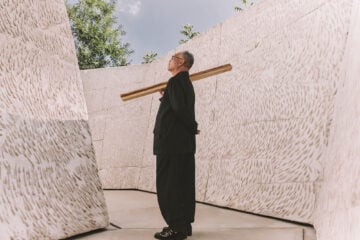
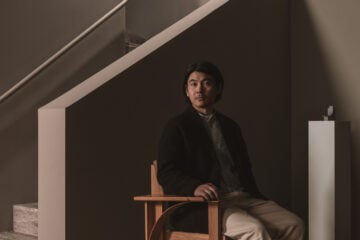
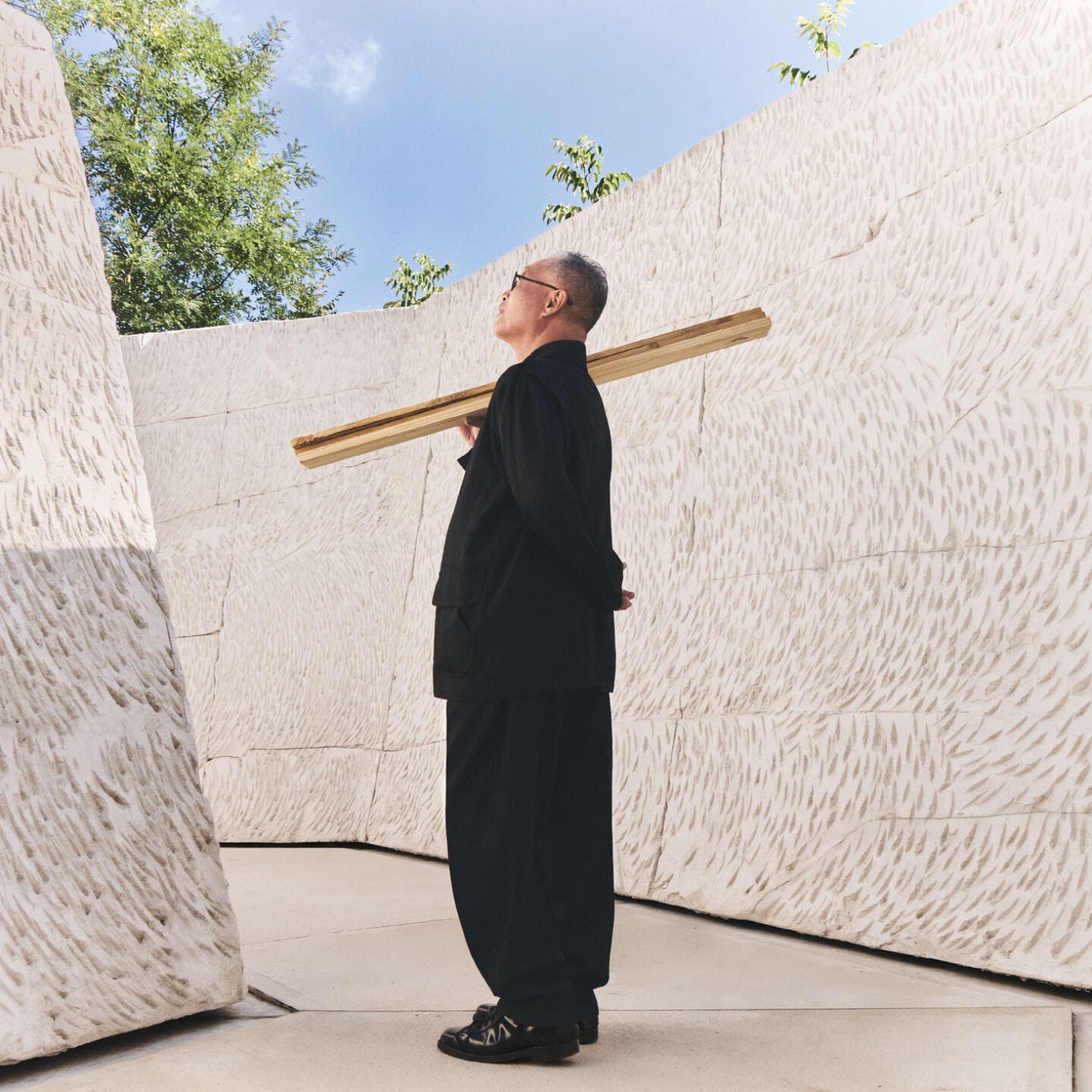
Tadashi Kawamata has been creating temporal installations from salvaged materials since the late 1970s — wooden accretions that appear to have grown organically from the architecture they inhabit. These symbiotic structures have been exhibited everywhere from the Venice Biennale to Documenta, the Centre Pompidou and MoMA PS1. This year, a new set of works will appear at Maison Ruinart in Reims, where Kawamata is the artist in residence for the annual curatorial program Conversations with Nature.
This Gallery Weekend, a dedicated in-situ work will be on display at the Ruinart Champagne & Art Bar in the PalaisPopulaire in Berlin. At the Ruinart Champagne & Art Bar, guests can experience Champagne masterclasses together with light food pairings, backdropped by Kawamata’s ephemeral works — ahead of their presentation later this year at Frieze London, Art Basel Paris and Art Basel Miami.
Born in Hokkaido, Kawamata studied painting at Tokyo University of the Arts before an allergy to oil paint redirected his practice. It was a shift that was as much literal as it was philosophical. Inspired by structuralist theory — Foucault, Merleau-Ponty,
Barthes — he arrived at the idea of art as process and relation rather than object. His first installation was the arrangement of a series of paintings into a single, sculptural form. Later, he stripped a painting from its wooden stretcher and realised that this utilitarian form might offer a more fitting structure for what he wanted to say. By 1979, he was building larger timber interventions in non-traditional spaces, a practice that accelerated after the 1982 Venice Biennale, when he used timber slats to physically extend the Japanese Pavilion into the Giardini.
“I construct, I deconstruct, I construct, I deconstruct, I construct...”
His works are radically antiformalist, their recycled materials and irregular forms deliberately at odds with the architectural spaces they often inhabit: “Nests” that bulge from museum facades, corbelled “tree huts” that hang in suspense above the urban landscape. Their formal power emerges through the use of a single material accumulated to excess: Five thousand wooden crates that cascade across the facade La Maréchalerie in Versailles; one hundred thousand chopsticks that weave together the exhibition spaces of Galerie Mennour in Paris; two thousand logs stacked as a funerary monument outside Kunstmuseum Thurgau in Switzerland. Each work is imagined by Kawamata, constructed with a team assembled from the local community, and later dismantled — ready to be reused once more. “I construct, I deconstruct, I construct, I deconstruct, I construct,” Kawamata says. “It’s like a flower. The flower grows, blooms and wilts, and the next year it blooms again. It’s a continuous ensemble, which exists in multiple sites: in Europe, in Japan, in America. Sometimes it blooms here, sometimes over there. ”While the scale, material, and form of his works may shift over time, Kawamata considers each piece part of a single, ongoing work — an evolving cycle, like those found in nature.
“Nest is a metaphor for shelter, home and trust...”
It is this ecological understanding that resonates with Maison Ruinart. Since 2008, the house has invited contemporary artists to reinterpret its heritage through the annual Carte Blanche program, and in recent years, that invitation has sharpened to a specific focus: Conversations with Nature. The series asks artists whose practices are rooted in natural thought to engage directly with Ruinart’s relationship to the land — a relationship spanning three centuries of attentiveness to soil, climate and vine. Past collaborators have included Tomás Saraceno, Nils Udo and Julian Charrière. With Kawamata, Ruinart turns to an artist for whom circularity is not metaphor, but practice.
For Conversations with Nature, Kawamata has created three works: Tree Hut, Nest and
Observatory that he describes as “a symbolic ecosystem” of protection, elevation and
observation. Suspended in the trees at Maison, Tree Hut will introduce a new form to the landscape, reframing our gaze by shifting attention upward. The work represents the latest iteration of a body of work that Kawamata has been developing since the early 2000s. Reminiscent of clandestine constructions found in self-built settlements, its form speaks to security and refuge as much as insecurity and precarity.
The nest is one of Kawamata’s most sustained and recognisable motifs: assemblages of untreated wooden planks that evoke both primitive refuge and urban lookout. “Nest is a metaphor for shelter, home and trust,” he explains. Both solid and ephemeral, this arboreal form will attach itself to the corner of Ruinart’s historic building. As the artist says, “Birds do not build their nests just anywhere.” The final work is less familiar but no less impressive: a six-metre-tall wooden observatory shaped like an inverted champagne bottle that mirrors the Roman chalk cellars in which Ruinart ages its wine. It too shifts the viewer’s perspective. “The cellar is a huge space that people can’t see from the ground, so I really wanted to connect with a totally empty space, or a big kind of hole, on top. The people go up to the sky.”
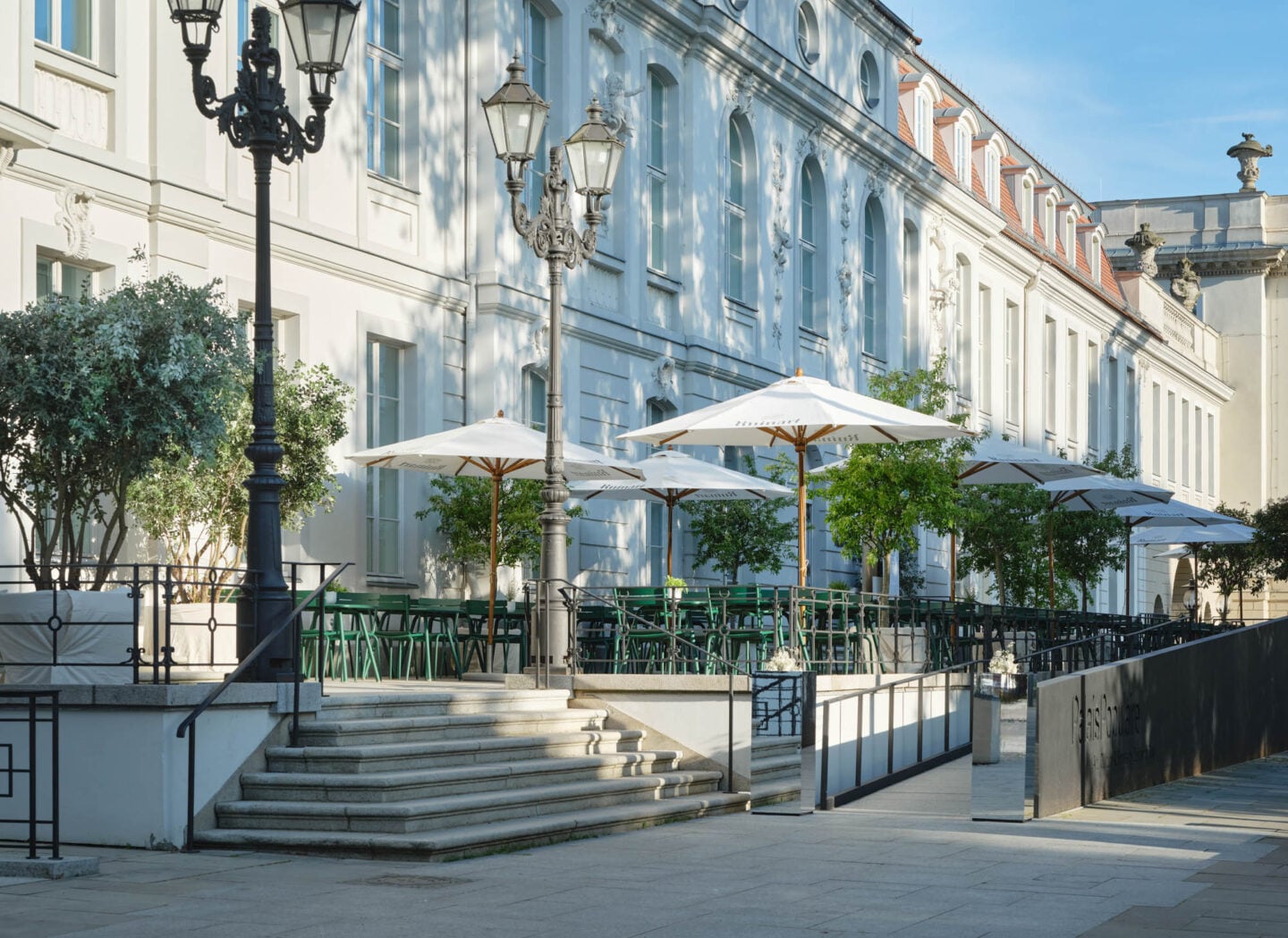
Image ©️ Noshe
Ruinart Champagne & Art Bar
PalaisPopulaire, Unter den Linden 5
Berlin-Mitte
April 30 to May 3, 2026
Daily from 1pm to 9pm
Ruinart recommends massvoll-geniessen.de